

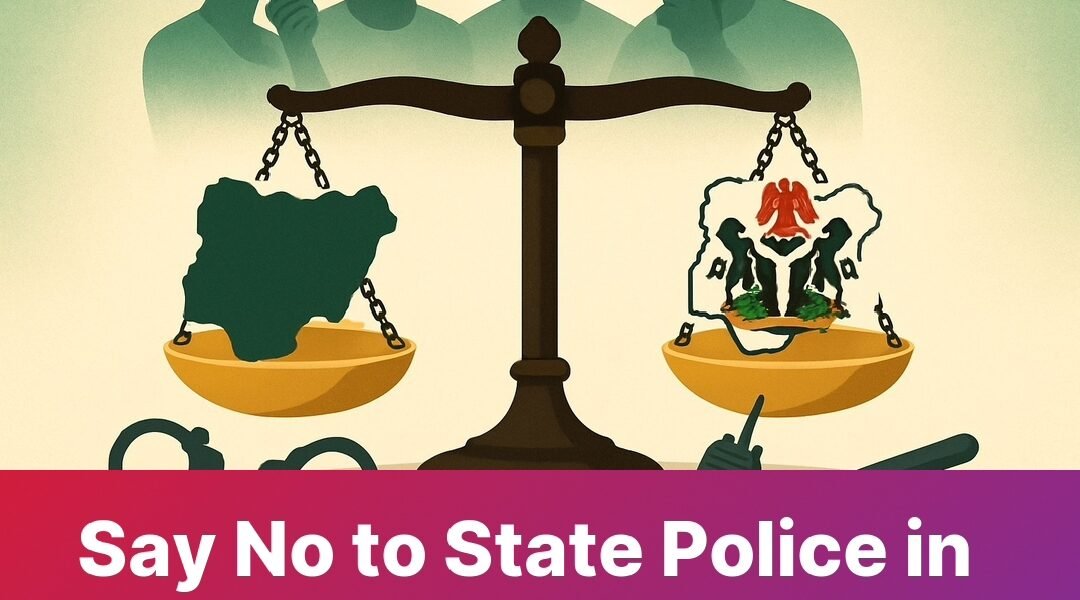
President Bola Ahmed Tinubu’s recent declaration, “I have to create state police,” is not something Nigerians can take lightly, especially after his rushed removal of fuel subsidy that has left millions in hunger and hopelessness.
At the time, the government claimed that fuel subsidies only enriched a few who diverted the funds. But Nigerians later realized that, for nearly two decades, fuel subsidy was perhaps the only policy that gave them any real relief.
Today, just as people were misled to support the removal of fuel subsidies in the past, there is now the false belief that creating state police across the country will put an end to crime.
The governor of Zamfara State, Mr Dauda Lawal, recently said that he knows where the bandits in his state are but does not have the authority to act. He claimed that if he had the power, he could end banditry in just two months. The belief that insecurity in Nigeria can be solved simply by giving someone control over a police force shows that we take the problem of insecurity in Nigeria far too lightly.
READ ALSO: The Revolution in Our Minds
I wish to state clearly that the problem of insecurity in Nigeria comes down to poor funding. The lack of enough manpower, poor equipment, weak training facilities and low morale among security officers all arise because of lack of funding.
Proponents of state police often point to the American model as an example of societies that thrive with state policing. But they fail to compare the resources of states like California, Florida, and Texas with states like Delta, Zamfara, Kogi, and Imo.
Interestingly, Florida’s budget for the 2025–2026 fiscal year, signed by Governor Ron DeSantis, is 117.4 billion dollars. In comparison, Zamfara State’s 2025 budget of ₦545.01 billion is about 368.25 million dollars when converted at an exchange rate of ₦1,480 to 1 dollar. This means Zamfara’s budget is only about 0.315 percent of Florida’s budget. Put differently, Florida’s annual budget is more than 317 times bigger than the annual budget of Zamfara State.
Can state governors afford to fund their own police without waiting for money from the Federal Government? If they could, would the state police officers get better pay, training, and equipment? Would this improve their investigative work and make them more motivated to fight crime?
Furthermore, how can we be sure that state police officers will not abuse people’s rights? How can we stop state governors from using the police to target their political opponents just like they have done with state independent electoral commissions?
Our opposition to the establishment of state police in Nigeria is grounded on the following points:
1 The establishment of state police does not effectively address the proliferation of arms, which remains the fundamental driver of insecurity in Nigeria.
2 The concept of state police implies an independent command overseen by a State Governor. Unfortunately, many governors are corrupt, power-drunk, and often dismissive of the doctrine of the rule of law.
3 State governors are already struggling with the payment of the new minimum wage and the implementation of capital projects that could create meaningful opportunities for ordinary Nigerians. Adding the responsibility of overseeing state police would only compound their burdens.
4 Most state governors lack the financial capacity to properly fund the police, as they are largely dependent on federal allocations to deliver essential projects in their states.
5 The unethical conduct of police officers already poses a serious security threat. State governors could explore other innovative solutions to this menace rather than being granted full command over a police force.
6 The establishment of state police or regional security outfits risks exacerbating mutual distrust among the federating units.
7 One of the critical issues of policing in Nigeria is funding. Have state governors demonstrated sufficient ingenuity in improving their internally generated revenue to adequately fund and equip a state police?
Recommendations:
1. The Nigerian government should recruit more police officers. The goal should be to recruit 60,000 new officers each year, train them well, and deploy them to every state. This will help achieve a ratio of one police officer for every 200 citizens within three years.
2. The lowest salary for a police officer should be 350,000 Naira.
3. To boost police morale, the government should provide full scholarships for the first two children of every officer, covering education from primary school through a master’s degree.
4. The government must invest in modern technology to improve intelligence gathering and help the police fight today’s crimes effectively.
5. The government must strengthen border security to stop the flood of illegal weapons. This will ensure that only the state’s institutions have the right to use force.
6. State governors should work with the federal government to oversee police activities in their states. This is to ensure officers do their job properly, but the governors should not directly control a state police force.
7. The government must create a security timestamp database. This system will record the exact time and details of every arrest to stop people from being held without reason.
8. Both federal and state governments must create real opportunities and reduce hunger for ordinary Nigerians to lower the high rate of crime across the country.
This petition was originally created by Onyemaechi Francis Nnana (Francis Onyema), an advocate of rational governmental policies as the mechanism for social change and 2027 presidential aspirant.
Kindly sign this petition if you believe the debate has shifted from “should we create state police?” to “how can we properly fund and reform the policing system we already have?”
SIGN THE PETITION RIGHT HERE